Introduction
4D flow MRI is a technique able to measure the velocity of blood flow in a volume of interest in three directions and over one averaged cardiac cycle. In coronary arteries 4D flow is challenging due to limited spatial resolution, long scan times and respiratory motion. For Kawasaki disease, this technique would be valuable by detecting high velocities indicative for occlusion and low velocities in aneurysms indicating thrombus formation risk. With in-house developed acceleration and motion compensation techniques we made 4D flow MRI of proximal coronary arteries possible in volunteers and a Kawasaki patient.
Methods
Coronary 4D flow acquisitions were acquired with in-house developed acceleration technique (PROspective Undersampling in multiple Directions, PROUD) with an acceleration factor of 8, enabling a voxel size of 1 mm3 in less than 13 minutes of scan time. Velocity encoding (VENC) was set to 50 cm/s. Feet-head respiratory motion was corrected using a separate real-time MRI acquisition. Anterior-posterior motion was corrected by rigid registration of motion states determined by the liver navigator. Two back-to-back scans were acquired and compared with a left main coronary artery 2D flow MRI acquisition. Systolic timeframes were discarded as image quality is affected by cardiac motion and flow is irrelevantly low.
Results
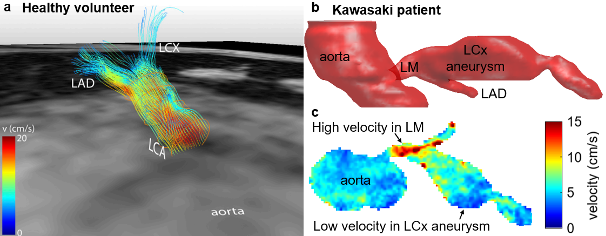
In 11 volunteer datasets proximal coronary flow (left main, left anterior descending, left circumflex coronary artery) was acquired. The data showed good scan-rescan reproducibility (concordance correlation coefficient of 20% at an average flow of 1.3±0.4 mL/s). 4D flow agreed well with 2D flow (1.5±0.5 mL/s, CCC of 20%). In figure 1 volunteer and Kawasaki examples are shown.
Figure 1. Velocity in a)volunteer, b,c)in a Kawasaki patient
Discussion/Conclusion
Only two studies have previously shown that coronary 4D flow MRI is feasible: in healthy volunteers1 and in patients with coronary artery disease2. In both studies advanced modifications to standard 4D techniques were necessary. For future application in Kawasaki disease, we will add motion-robust acquisition techniques(e.g. radial sampling), dual-VENC approaches for more accurate measurements of low velocities (in aneurysms) and super-resolution reconstruction to the current framework.
1¬Blanken et al. Front Bioeng Biotechnol. 2021
2Lichthardt et al. Magn Reson Med 2026