Introduction:
Kawasaki disease (KD) is a systemic vasculitis and the leading cause of acquired heart disease in children < 5 years of age in industrialized countries, mainly due to the development of coronary artery aneurysms (CAA). Although most coronary aneurysms eventually regress, the time required to achieve resolution and the exact size thresholds that predict regression are not yet fully established.
Methods:
Descriptive study including 696 patients with KD registered in the Spanish KAWA-RACE registry (prospective cohort, 2018-2025). Coronary artery aneurysms were analyzed and classified according to standard criteria (McCrindle, 2017). The rate of complete resolution and the time to resolution of coronary aneurysms were assessed. The association between the severity of coronary involvement—defined by the worst coronary z-score and the maximum z-score reached at diagnosis—and time to aneurysm resolution was evaluated using Spearman’s correlation coefficient.
Results:
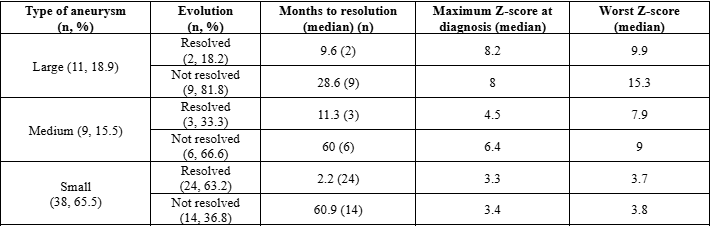
A total of 58 patients (8%) developed coronary artery aneurysms. Of these, 38 (65.5%) were classified as small, 9 (15.5%) as medium, and 11 (18.9%) as large aneurysms. The rate of complete resolution was inversely related to aneurysm size: 63.2% in small aneurysms, 33.3% in medium aneurysms, and 18.2% in large aneurysms. Time to resolution showed a clear association with aneurysm size. Small aneurysms exhibited the shortest time to resolution (median of approximately 2 months), whereas medium and large aneurysms required longer periods (median of around 10–11 months).
A significant positive correlation was observed between the worst coronary z-score and time to aneurysm resolution, as well as between the maximum z-score achieved and time to resolution, indicating that more severe initial coronary involvement was associated with delayed regression.
Conclusions:
Coronary aneurysm size and the initial severity of coronary involvement are significantly associated with time to aneurysm resolution in KD. Patients with greater initial coronary impairment show slower or incomplete regression. These findings support the need for closer follow-up and earlier, more intensive therapeutic strategies in patients with higher coronary z-scores, and highlight the prognostic value of coronary z-scores in the management of KD.
Coronary Aneurysm Size and Time to Resolution in Kawasaki Disease: Data from the Spanish KAWA-RACE Registry
M de las Parras