Introduction:
Early identification of patients at increased risk of coronary involvement in Kawasaki disease (KD) remains a major clinical challenge. In this context, N-terminal pro–B-type natriuretic peptide (NT-proBNP), a biomarker of inflammation and myocardial stress, has been proposed as a potential tool for risk stratification of coronary abnormalities and aneurysm development in KD. However, its diagnostic and predictive utility according to age and type of cardiac involvement has not been clearly established.
Methods:
A descriptive study was conducted including patients with KD enrolled in the Spanish KAWA-RACE registry (prospective cohort, 2018–2025). NT-proBNP levels measured during the acute phase were analyzed, stratifying patients by age groups and by the presence of coronary artery aneurysms (CAA) or other coronary abnormalities. Diagnostic performance was assessed using receiver operating characteristic (ROC) curves, sensitivity, specificity, and positive and negative predictive values at different optimal cut-off points.
Results:
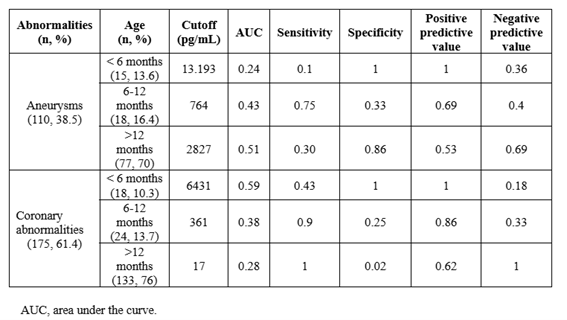
The diagnostic performance of NT-proBNP was analyzed in 285 patients, using the acute-phase value nearest and prior to IVIG administration. Of these patients, 110 (38.6%) presented coronary abnormalities and 175 (61.4%) developed CAA. NT-proBNP performance was heterogeneous depending on age and type of coronary involvement. Notably, in infants younger than 6 months, markedly elevated NT-proBNP levels identified subgroups at high risk of developing aneurysms (NT-proBNP ≥13,193 pg/mL) and coronary abnormalities (NT-proBNP ≥6,431 pg/mL). In patients aged 6–12 months, NT-proBNP concentrations ≥764 pg/mL showed acceptable sensitivity for detecting CAA, while levels ≥361 pg/mL demonstrated good sensitivity for identifying coronary abnormalities. No patient older than 12 months with NT-proBNP levels below 17 pg/mL developed coronary involvement.
Conclusions:
Elevated NT-proBNP levels in specific subgroups, particularly in infants younger than 6 months, may justify intensified therapy and closer cardiologic follow-up. These findings support the role of NT-proBNP as a risk stratification tool in KD, whose interpretation should be integrated with comprehensive clinical and echocardiographic assessment to optimize early management.
Age-Specific Diagnostic Performance of NT-proBNP for Coronary Risk Stratification in Kawasaki Disease: Data from the Spanish KAWA-RACE Registry
M de las Parras