Introduction: Despite being the leading cause of acquired heart disease in pediatric populations in industrialized countries, the etiology of Kawasaki disease (KD) remains unclear. Clinical, epidemiological, and immunological evidence suggests that infectious agents, particularly viruses, may act as triggering factors in genetically predisposed children. Recent spatiotemporal studies have reported correlations between outbreaks of respiratory viruses and KD incidence, although data in the literature remain limited.
Objectives: The primary aim of this study was to identify the most frequently detected viral and bacterial infections in children with KD and to evaluate their possible association with the development of coronary complications. Secondary objectives included exploring the potential role of infectious agents in KD pathogenesis and comparing infection incidence across three age groups (<6 months, 6 months–4 years, >4 years).
Methods :We conducted a retrospective, single-center cohort study including pediatric patients (30 days–18 years) diagnosed with KD at Bambino Gesù Children’s Hospital, Rome, between March 2005 and April 2024. Infections were assessed during the acute phase of KD using PCR, serology, and microbiological cultures. Patients were stratified into three age groups (<6 months, 6 months- 4 years, 4 years) and classified as having complicated or uncomplicated KD based on coronary artery Z-scores (Boston Z-score).
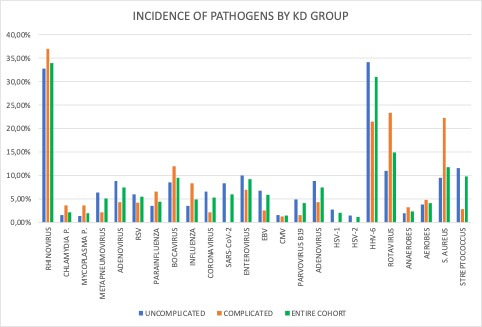
Results: A total of 476 patients were included, of whom 78.6% had uncomplicated KD and 21.4% developed coronary complications. The most represented age group was 6 months–4 years, regardless of disease severity. Viral infections were markedly more frequent than bacterial infections (approximately 89% vs. 11%). Human herpesvirus 6 (HHV-6) was the most frequently detected pathogen in uncomplicated KD, while Rhinovirus was the most common in complicated cases. No statistically significant differences in infection distribution were observed between complicated and uncomplicated KD or among age groups, except for Rhinovirus and Epstein–Barr virus in specific sub-analyses.
Discussion: This study highlights the potential etiological role of Rhinovirus and HHV-6 in the onset of KD in genetically predisposed individuals. The absence of a statistically significant association with the development of coronary complications suggests that infections during the acute phase of KD do not influence disease severity or clinical outcome.
A single-center retrospective cohort study on the correlation between Kawasaki Disease and infections in Pediatrics
L Ariaudo