Introduction Standard follow up recommendations after initial treatment of KD exist to identify new and residual cardiac changes. Timely follow up decreases risk of morbidity related to coronary artery changes after KD and improves patient/family and staff experience. In our large pediatric quaternary referral hospital, 56% of KD patients follow up in the Cardiology clinic within 14 days post-discharge (standard of care:7-14 days). Here, we report improvement from 56% to 75% within six months of this QI project.
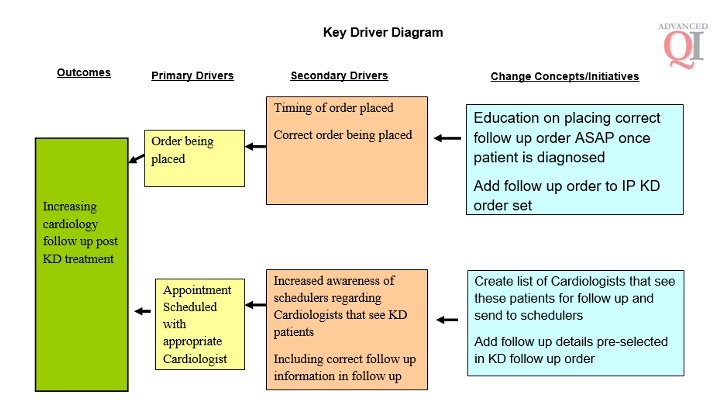
Methods A key driver diagram was used to identify barriers and to develop appointment scheduling strategies. Common barriers identified are the lack of clinic availability and cardiology coordinators, time required for changes in EMR. The most effective interventions were initially centered around educating resident physicians, coordinators/schedulers in inpatient services and KD providers (including rheumatologists). We provided education to increase awareness of the importance of KD follow up for the inpatient physicians that could be presented in a meeting and posted in the resident workrooms. Our second PDSA cycle included changes to the KD order set that allows the follow up order to be placed at the time of diagnosis of KD and to ensure the order contains the appropriate information and is routed to the appropriate group for scheduling. During the baseline period of 6 months, we noted improvement from 56% to 75%.
Conclusions These strategies have proven to be successful in improving the follow-up visits. It is expected that as we continue with quarterly data review in multidisciplinary meetings, we identify barriers and potential interventions, that the % of patients with KD who follows up with cardiology (and rheumatology in IVIG refractory cases) will continue to improve. We also want to sustain the rates for at least 6 months. Interventions may differ based on individual institution needs though follow-up should be considered as an element of quality for all KD programs.
Improving timely Cardiology follow up visits post- discharge for Kawasaki Disease patients in a quaternary referral hospital in the United States: a Quality Improvement Project
SK Sexson Tejtel, MD, PhD, MPH