Introduction:
Kawasaki disease (KD) is a systemic vasculitis and the leading cause of acquired heart disease in children < 5 years of age in industrialized countries, due to the development of coronary artery aneurysms (CAA).
Methods:
A descriptive study was conducted using data from the Spanish KAWA-RACE registry (prospective cohort, 2018-2025). Epidemiological, clinical, laboratory, treatment-related, and outcome data were analyzed. Complete and incomplete forms of KD were compared. Univariate and multivariable analyses were performed to identify risk factors for complications, particularly coronary involvement.
Results:
A total of 696 patients were included, of whom 138 (37.8%) were younger than 12 months. Complete KD more frequently fulfilled the classical diagnostic criteria (p=0.001). Among non-classical manifestations, complete KD was more often associated with irritability (50.8%, p = 0.002), whereas incomplete KD was more frequently associated with gastrointestinal symptoms (60.6%, p = 0.005).
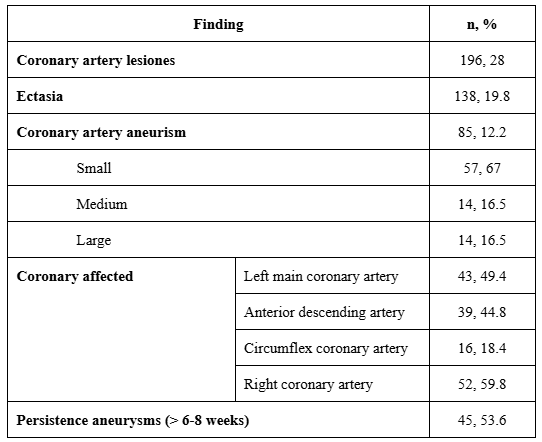
Coronary involvement was observed in 196 patients (28%), with ectasia being the most common finding (138 patients, 19.8%). Nearly half of the patients with coronary abnormalities developed aneurysms (85 patients, 12.2%): small (57, 67%), medium (14, 16.5%), and large (14, 16.5%). Aneurysms predominantly affected the right coronary artery (59.8%), and more than half persisted after 6–8 weeks of follow-up (53.6%).
In multivariable analysis, hypoalbuminemia was identified as an independent risk factor for complications. Age ≤1 year and fever duration longer than 10 days were associated with the development of coronary artery aneurysms.
Japanese predictive risk scores demonstrated high specificity (80–90%) but low sensitivity (15–32%) for predicting coronary lesions, aneurysms, and intravenous immunoglobulin (IVIG) resistance. These findings highlight their usefulness in identifying high-risk subgroups, while also underscoring their limited value as screening tools outside Asian populations.
Conclusions:
Incomplete KD shows a lower expression of classical diagnostic criteria, which may delay diagnosis and treatment. Hypoalbuminemia, prolonged fever, and age under one year are associated with an increased risk of coronary complications. Validation of predictive models and identification of reliable biomarkers are needed to improve risk stratification and optimize the management of patients with KD.
Clinical Characteristics and Coronary Risk Factors in Kawasaki Disease: Results from the Spanish KAWA-RACE Registry
M de las Parras